

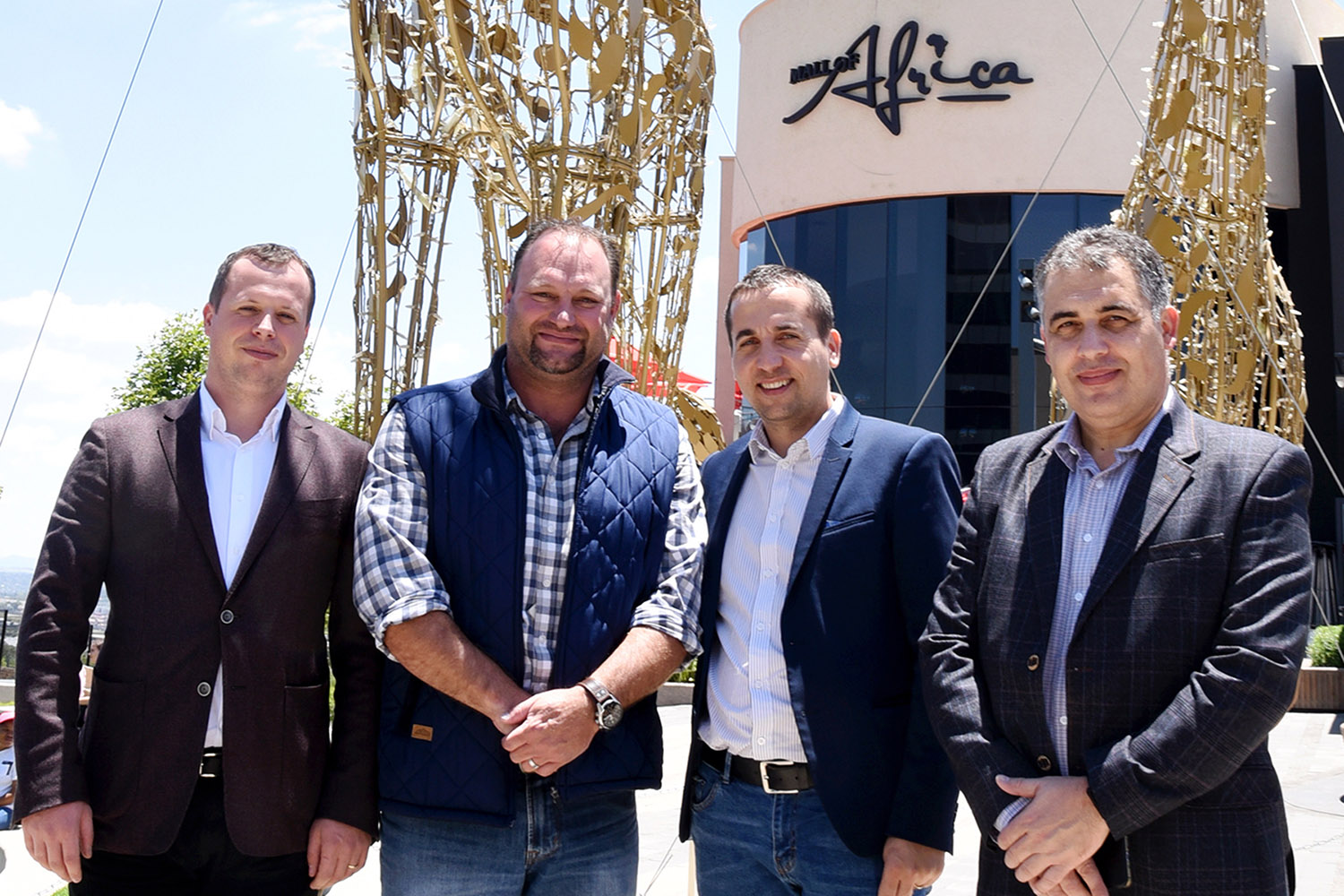
Wessel with the Romanian delegation at the at the Mall of Africa recently. Iulian Ciobotaru (technical director Openville), Wessel Boshoff (Atterbury group operations manager), Marius Cusenm (Iulius technical audit) and Viorel Herdes (Iulius cleaning services director)
It has been a round decade in the saddle for Atterbury’s group operations manager, Wessel Boshoff, and in these 10 years much growth has taken place, including expansion across the borders. We find out from Wessel how his work life has evolved as the company has grown.
What was your original role when you started in 2008?
I started in October 2008 and originally looked after the South African portfolio from an operations/technical perspective. The buildings had started to accumulate and from an asset management point of view certain technical requirements needed to be incorporated. We were growing at a rapid speed and soon we also had buildings in Mauritius, Namibia, Ghana, Zambia, Mozambique, Cyprus, Serbia and Romania. Atterbury had to ensure that the guiding principles and expertise remained at the same level, which is where my role started to grow.
And what do your responsibilities entail today, 10 years later? How have your duties changed?
Over time I became much more involved in the design and technical planning of the systems/operations utilised at the properties, to help reduce costs and prolong the lifespan of equipment. I also assist with the day-to-day asset management of the properties by means of technical and operations services support, for existing and new projects. Duties don’t change as such, they just become more demanding as the portfolio grows.
What would you say has been the biggest change within Atterbury in the decade since you’ve been on board?
Atterbury has not changed much since I started; I’d say our biggest change was that we moved offices twice in 10 years! We have been very fortunate in that Louis van der Watt created a company with a strong foundation where we’ve always maintained our core values and stayed true to our slogan, It’s a matter of association.
A few representatives from the asset management team recently hosted Atterbury’s Romanian partners on an official visit. Tell us more.
We hosted a delegation of 13 members for five days. The objective was for them to see how we execute our various functions, from leasing, budgeting and operations to new technology and also how the Atterbury teams manage our day-to-day tasks.
How busy was their itinerary? What did they enjoy most about the visit, do you think? I’m sure there was a braai somewhere on the agenda!
It was quite a tight schedule, with back-to-back meetings and activities from the minute they stepped foot on African soil. I think on the work side they particularly enjoyed the detailed site walk we had at Mall of Africa and the visit to the PwC building. We included a weekend away, when we hosted them on a game farm in the Kalahari and they had the opportunity to see rhinos and buffaloes… something none of them had ever seen other than on TV! There were sundowners on a Kalahari dune and a proper braai in the red Kalahari sand, which I think our new friends won’t easily forget. Back in the city we even squeezed in Sunday lunch at the Maboneng market in Johannesburg before they travelled back to Romania on Sunday evening.
It must be very interesting to work with international partners. Is the way the European partners approach the management of malls very different to the way Atterbury does it? Have there been interesting learnings for you and your team, working with them?
I’ve been to Romania on three occasions, and it really is fascinating to see the different ways of working to achieve the same results. It is a well known fact that the workforce in Romania is highly skilled and it is insightful to observe how they approach asset management.
And conversely, in terms of skills transfer, what do you think was most useful for the Europeans to learn from the way Atterbury does things?
I can truly say from observing how other businesses work, Atterbury really has a rare talent for optimising income and reducing costs by simply questioning the processes and considering different ways of executing tasks. I think they could see the benefit of stepping back, holistically reviewing the scenario by questioning the processes and to critically question how things might be done differently.
In your experience with malls, what does a typical week look like in terms of what needs to be done?
This changes on a daily basis and one’s to-do list is never followed, because every day brings a new challenge or unforeseen crisis behind the scenes that requires attention right then!
What has been the biggest crisis at a mall that you’ve ever had to manage?
I must say that to date we’ve managed to prevent any really serious incidents due to our stringent procedures that are continuously put in place at our sites. The most challenging event we’ve had was the opening of the 130 000 sqm Mall of Africa; we had to be prepared for any crisis that might have occured when opening a centre of that magnitude. Fortunately the biggest crises on that day happened on the highways leading to Mall of Africa!
What would you say have been the most important changes that Atterbury has implemented over the years in managing malls more and more efficiently?
Firstly, the streamlining of processes between developments, asset management and our finance department. And secondly, installing systems that reduce maintenance and recurring costs, which increases income – we are constantly seeking to improve on all aspects.