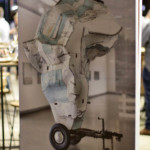


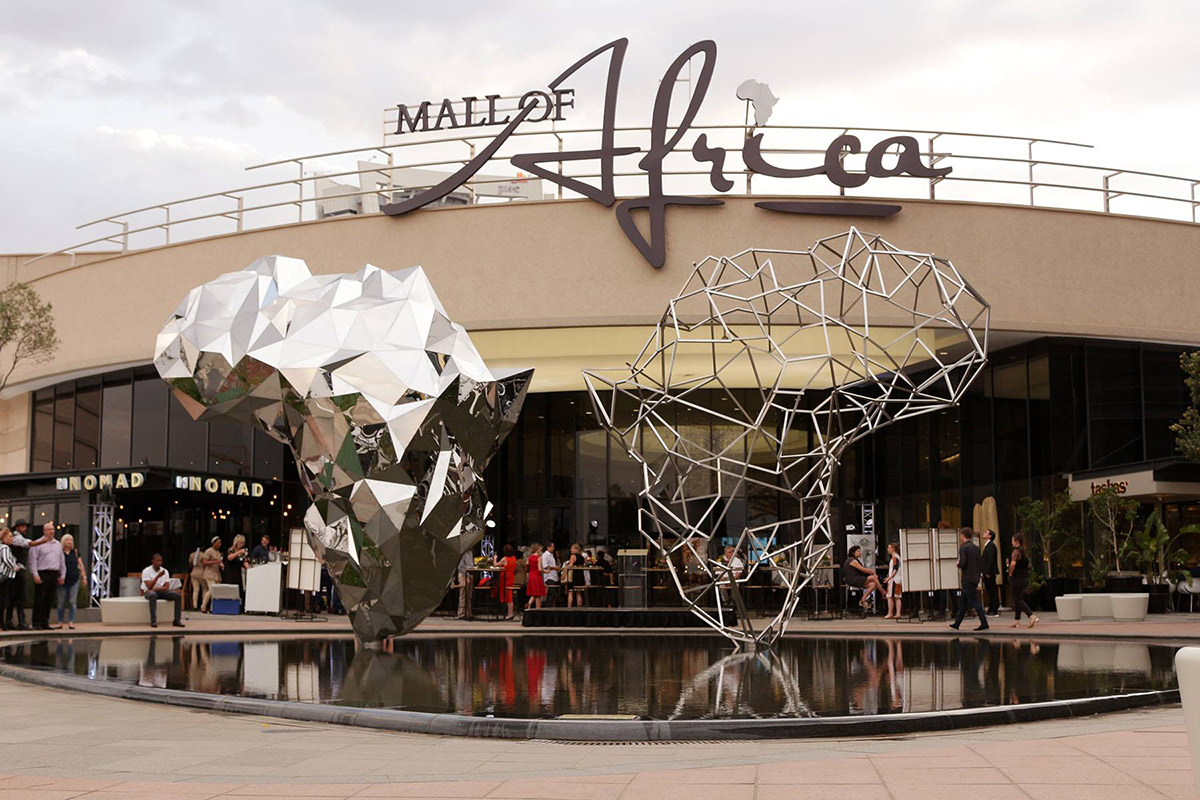
When artist Rina Stutzer was commissioned by Atterbury and Attacq as joint owners to create a sculpture for Mall of Africa, she embarked on an intense 18-month project, and the magical reflective double-Africa diptych that welcomes visitors to the mall today is the result. In addition, the two fifth-scale maquettes of the finished work are installed in the reception area at Die Klubhuis. We quizzed this talented and versatile artist on the details of this remarkable installation.
How would you describe the work to someone who hasn’t seen it?
There is No Time Like the Present constitutes a large-scale mirroring diptych installation of reflective crystalline continental shapes, charged with the efficacy of its progressive surroundings and by the same token, projects the ever-changing face of Africa.
I present Africa to Africa, facing one another, engaged in a dynamic visual dialogue, one side emergent while the other telling of the ideal construct.
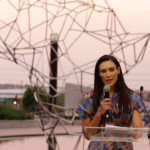
The pair counterpoints one another as the one’s formal characteristics may be described as a criss-crossing linear frame, while the other as a faceted polygon-shaped super-mirror stainless-steel, gem-like mass.
This linear Africa consists of 320 pieces of 30mm solid square bar, combining grade 304 and 316 stainless steel, whereas the faceted sculpture is created from 608 triangular and polygonal plates of grade 304 stainless-steel mirror plate. Each structure measures 5.5m in height, 5.27m in width and 2.3m in depth. The total width of the full installation is around 11 meters.
When I approach the sculpture post-installation it is always in a different mood, ever-changing and dynamic. The reflections mirror the face and mood of its environment, moving and changing to the rhythms of the lively public place. With passersby strolling past the sculpture, figures reflect, fragment, merge, scatter and assimilate inside the Africa. In it I see various elements constantly arriving and becoming.
What was the concept and was there a specific brief from the client?
Honourably and sensitive to artistic integrity, the client’s brief avoided dictating a concept or sculptural processes, and neither did they prescribe visual outcomes. The client did however have the highest expectations of the project in terms of: a clear artistic consideration of the site context, that the sculpture behaves in accordance with the site-specific environment, that the sculpture plays an interactive role and engage with the public and finally, that the sculpture activates the public place in an engaging manner.
Furthermore, the client guided the development of the concept, from initial proposal to the maquette phase (a fifth scale of the final installation) and offered both constructive and stringent criteria on the various processes involved in the development of the project, the eventual choice and finishing of the materials as well as the scale and positioning thereof.
When I was tasked with presenting a proposal for the designated space, the African continental form, that I had been exploring, constructing and visually deconstructing over the past decade, immediately came to mind. The indisputable visual and conceptual strength of the African continent stood firm as conceptual activator for the space. The shape of Africa, I believe, is undoubtedly the most recognisable and beautifully shaped continent, connoting a space of heightened, fleeting and contrasting experiences.
Although my earlier studies of the African construct explored a different aspect of Africa (such as the African-shaped caravan) dealing with movement and migration, the installation at Mall of Africa aimed to recognise and celebrate African ideals and progress. This representation aimed to suggest ideas of power, elegance and desirability, as the context of the sophisticated high-end market place, surrounding the sculpture, demanded this.
The reflective material behaves in the same way its environment behaves, therefore the choice of material, continues to play a supportive role in the concept, by means of “becoming” its surroundings. The materiality of the sculpture animates the artwork, gives it life and makes it interactive.
Was the title of the work there from the start or did it come after the work was finished? How did you arrive at the title?
The title developed as the sculpture took shape. There is No Time Like the Present aims to celebrate the fleeting nature of life and the inherent concept that beauty is heightened because of its fleeting nature. Ultimately the concept embraces the present, reflecting an ever-changing present, with the ongoing movement of passersby.
When confronted by the African “mirror” the moment calls for immediate action. The notion of an absolute present, of the immediacy of the now acts as a catalyst, calls for a response, a reaction, an interaction, a pose or a performance, perhaps an appreciation. This is what the title aimed to capture and aimed to instil in the artwork. The “mirror” effect charges the work with allure and kindles intrigue.
It really is a huge work… how long did it take from initial concept to final installation?
The research component of the project commenced in February 2017, when I started exploring characteristics of different stainless-steel types to determine the ideal choice of material suitable for this design. A suitable stainless-steel grade was selected according to the appropriate reflectivity, its corrosion resistance and its cleaning behaviour. Small-scale maquettes in various materials ranging from clay to wood were meticulously refined until the diptych was ready to be upscaled. Construction was executed in collaboration with Dionysus Sculpture Works (DSW), for this project the team consisted of a specialised team of 15 artists and artisans. During the 18-month construction period, the two Africas, due to the immense scale, occupied the total DSW studio space.
What was the most challenging aspect of creating the work?
The sensitive nature of the unblemished metal posed handling challenges. Although stainless steel is a hardy, corrosion-resistant alloy, the super mirror plates are extremely sensitive to touch, posing many challenges when sculpture components are manoeuvred around the studio. To protect the mirror surface, a vinyl film is wrapped around the structure, held intact throughout the making process and obscuring the material until installation. The reflective surface was only exposed after the installation, keeping the artists in suspense for the full 18 months! The encompassing effect of the super-mirror stainless steel was only truly appreciated on the post-installation reveal.
As this project amounts to the largest and heaviest project that I have been a part of, it posed gigantic movement and handling challenges.
The most technical challenge was to avoid any misalignments occurring on the joins between the mirror plates, as 608 triangular and polygonal plates joined at various angles to shape Africa. There was no margin for error. A misalignment of one millimetre in one corner could accumulatively result in a centimetre misalignment elsewhere. The most challenging spot on Africa, where 12 triangular plates meet and join, took meticulous engineering to assemble.
Did the final product match the picture you had in your mind when you started it; or were there changes during the course of the process?
When the artist’s rendering is compared to the final installation in situ, it is astonishingly similar. Yet the material’s incredible response to light, which could only be discovered post-installation, was unforeseen. As the stainless steel is influenced by ambient conditions, in particular light, the sculpture appears to change mood, according to time of day and surrounding moments and happenings. This ever-changing and dynamic quality surprises me, as it behaves differently every time I look at it.
Working on a sculpture in a studio under a roof creates the impression of a larger scale. In my experience, when the sculpture is installed in situ outdoors, its comparison with its vast new surroundings changes one’s perception and it seems to reduce in scale.
Tell us a bit more about yourself as an artist – has sculpture always been your passion or do you work in other mediums too? Can you describe what attracts you to sculpture as a medium?
My aim is to experience, explore and specialise in various forms and ways of art making. Although I have a Masters degree in fine art with a focus on painting, I constantly aim to expand my abilities and field knowledge depending on the concept. In my opinion, the material and method follow the idea. When learning and mastering new “languages” to use as visual communication, the artist has to undergo constant disciplined research-based development, which offers growth and evolution.
Although I value both painting and sculpting, sculpture offers a completely different experience to painting. The third dimension of sculpture asks the viewer to be more physically interactive, to discover the third dimension through movement. In the artwork There is No Time Like the Present a fourth dimension becomes visible, through the behaviour of the reflective mirror. The mirror offers an ongoing catalyst or effect, which allows for constantly new appearances to shift over the surface. These potential characteristics of sculptural form and materials fascinate me.
Technical difficulties involved in the sculpting process initiate collaboration with numerous specialists from various fields. These collaborations offer rewarding field knowledge and stimulate alternative applications and development of your artwork. On the other hand, sculpture is demanding since the artist works with a structured scope, must employ good organisation skills, be conscientious with the budget, plan and manage time wisely.
Where do you work from?
I operate in two distinctly different studio environments, Bron Huis studio and DSW studio, which offer diverse facilities enabling different approaches. The Bron Huis is the incubation hub were research and planning take place, concepts germinate, pre-sketches drawn up, work on paper happens, as well as the preliminary 3D modelling in materials such as clay and balsa wood. This space offers a clean, organised and calm zone for reflection and fine work. However, There is no Time Like the Present demanded our full attention at Dionysus Sculpture Works (DSW) art studio and foundry, a place of alchemy, where materials change in appearance and form. The bustling industrial foundry and studio is operated by an up-beat collective of skilled artists and artisans, who take on large-scale modelling, mould-making, casting and finishing, working in materials such as clay, wood, resin, plasters, different metals, different natural stones and beyond.
What happens after you finish such a massive project… are you already busy with the next work, or how do you regroup?
My wise advice to creatives: after completing a large project, avoid post-project-blues by diving head first into the next programme! Whether it is conceptualising and developing your follow-up project, planning your next art residency abroad or even spring-cleaning your studio after a project, you need to immediately enter the next deadline entry on that diary page…