

Giving shoppers an exceptional shopping experience, and turning a shopping mall into a space of breathtaking beauty were challenges that the architects of Mall of Africa embraced and delivered on. Tia Kanakakis from MDS Architecture gives insight into the largest mall ever built in SA in a single phase…
Congratulations with a very impressive job! How would you describe the MoA in terms of what it means architecturally?
The Mall of Africa will set a new benchmark in retail design that will set South Africa and the broader Africa on the map in terms of retail development. The combination of excellent architecture combined with the leasing expertise on the project, all placed in a new urban framework will provide the catalyst for a new CBD. The Mall of Africa has been designed and developed by Africans, but it can stand proud alongside the most outstanding shopping centres globally.
How would you characterise African architecture? Is there such a thing, and is the MoA in any way reflective of this?
Africa and South Africa has a diverse context for the built environment as it comprises many extremes, from rural architecture which is specific to each culture and social element, to architecture that can stand proud alongside high-end international architecture. That is the beauty of African architecture as it responds contextually to its environment, cultural and demographic need. The Mall of Africa has been designed and developed by Africans, but can hold its own on an international platform.
What were the biggest challenges when designing a complex of this scale?
I would say that it has been two-fold. To hang on to the vision of the design of the mall that was set out at inception with Atterbury, and to marry this vision with the budget constraints that arise as the project unfolds. Atterbury wanted to create a landmark development, but at the same time must be mindful of the feasibility and the return on the investment. At the end of the day we are appointed on the strength of being commercial and retail specialist architects and as such we must drive the design vision within the commercial aspects of the project. It is a very important factor when one has to remain focused on a single vision for over four years to bring such a project to fruition. Fortunately the Atterbury team is very involved in the day-to-day running and has a vested interest in streamlining the commercial aspects of the development.
Did the fact that this was to be built in a single phase impact on the way it was designed at all?
Yes it did. Most of the large centres in South Africa were initially developed as smaller centres which expanded and grew over time. This does not allow the optimum design development for a centre. With the Mall of Africa being designed in a single phase to accommodate 130 000sqm of leasable retail area, we were able to incorporate best planning and design principles to optimise the shopper flow through the mall, the positioning of equal banks of parking to all entrances, ease of access to enter the centre, tenant leasing initiatives as well as a palette for creative design on a greenfield site.
Where did you go for design inspiration for the mall?
Our practice is renowned for being one of the leading retail architectural practices in the country, with our partners having a wealth of in-house experience as our practice has been involved with shopping centres for over 60 years. We also travel extensively, reviewing architecture and specifically retail trends around the world on a frequent basis, while applying this in our local context to have a very good understanding of what works and what doesn’t work in our country. Specifically for the Mall of Africa the predominant inspiration was taken from architecture and elements that inspire wide malls and high shopfronts with an abundance of natural light in the centre.
Does MoA reflect any of the current global trends in architecture?
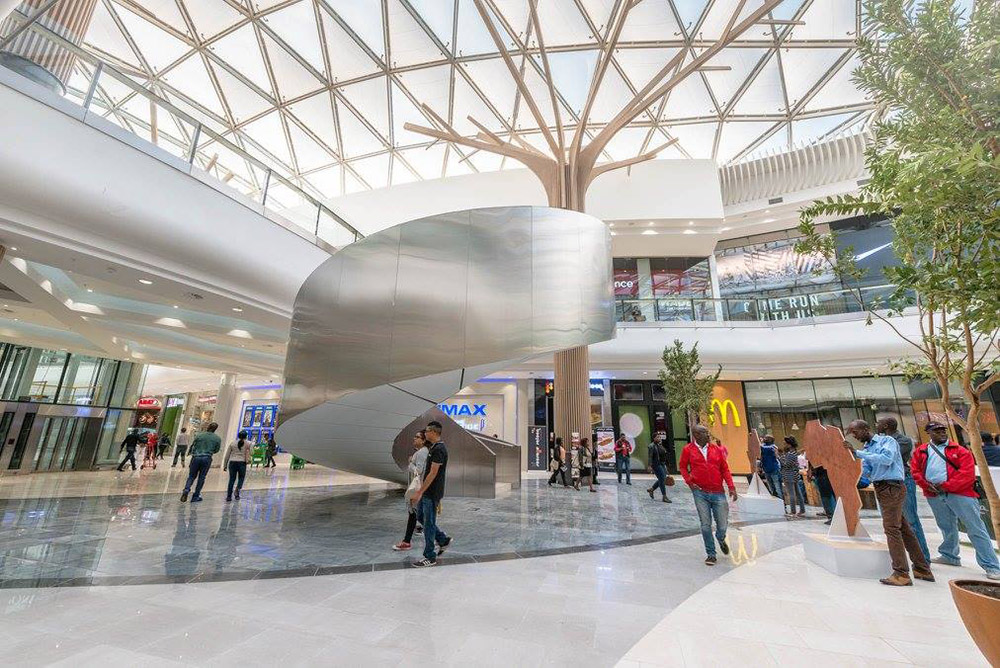
The Mall of Africa incorporates many global trends in retail architecture. As mentioned, the design incorporates the fantastic use of glass with high shopfronts and key structural glazed elements, an abundance of light making a uniquely pleasant experience in the shopping centre while allowing the shopper to feel connected to external conditions. To have a centre that is not merely an introverted development but one that opens up to the exterior and addresses the urban framework of the greater emerging city that will become the Waterfall CBD, is a major trend in global architecture. Many cutting-edge digital trends have also been incorporated into the design, in terms of signage and wayfinding for the mall with digital interactive information touch screens, apps for click-and-collect on-line shopping, apps for parking and parking payment to mention a few. In terms of a tenant mix, retail trends also speak to not merely repeating more of the same national, major and usual tenants in the centre. One must endeavour to integrate new brands and stand-alone brands. At the Mall of Africa this was certainly achieved with the tenant mix, where there are nine new shops showcasing brands never incorporated before in any other centre in South Africa – a large feather in the cap of the leasing team!
Was there anything in your original plans that had to be abandoned because of logistical or other reasons?
No specific part of the original plans were abandoned, which is quite a unique position from a design point of view. The only major rationalisation that I can think of with the design is that the level of the building was reviewed with the extent of basement parking. As ground conditions became known with more geological, water-table and site-condition information that became available it was decided to alter some of the extent of the basement parking areas, with the level of the building in relation to the optimum ground level to best rationalisation extensive earthworks and piling requirements. This did involve some re-design of the parking extent and parking areas at the inception stage of the project.
What is your favourite feature of the mall?
That is a little difficult to say as I’ve been working on this project for four years so there are many design elements that have taken a lot of effort and inspiration to refine to the best possible solution. If I had to isolate one element I would say that it is the ETFE roof over the central area, which ties the extensive looped mall walkways together. This is a roof of about 4 500sqm that is supported by a suspended concrete ring beam and only four columns. The ETFE roof comprises inflated pillows on an undulating diagrid – an engineer’s nightmare but an architect’s dream! This is one of my favourite elements in the mall as its shape is reminiscent of many of the design inspiration lines in the mall; it’s made of recycled tin and metal and is a very green product. The design development of the ETFE roof took close to a year to complete. There is an extensive LED lighting design that has been combined with the ETFE roof. The LED lighting design will provide lighting and animation to the key centralised area. It is an amazing roofing feature and has become a talking point in the mall after opening.
Is there anything you would do differently if you were to start on this project all over again?
I’d change nothing from a design aspect as I believe we’ve responded to the requirements of Atterbury’s initial brief. In retrospect, one of course learns through experience and our team may have approached some of the planning and procurement requirements during construction slightly differently, due to the challenges that arose in trying to bring such a large single-phase retail development to fruition.
What architectural features would you point out if you were to take people on a tour of the mall?
The shopping centre is a collective experience in my view, with many subliminal design elements and architectural features that make up a visitor’s shopping experience and how they feel within the space of the mall. It’s therefore not only one element that makes the mall a unique place to be in but the combination of many architectural design features. At the end of the day the intention of good retail design in my opinion is one where the architectural design enhances the retail experience by allowing the tenants to showcase their display areas and merchandise in a unique manner. The phenomenal opening of the mall and the ongoing number of shoppers visiting the mall is a testament to this success.