

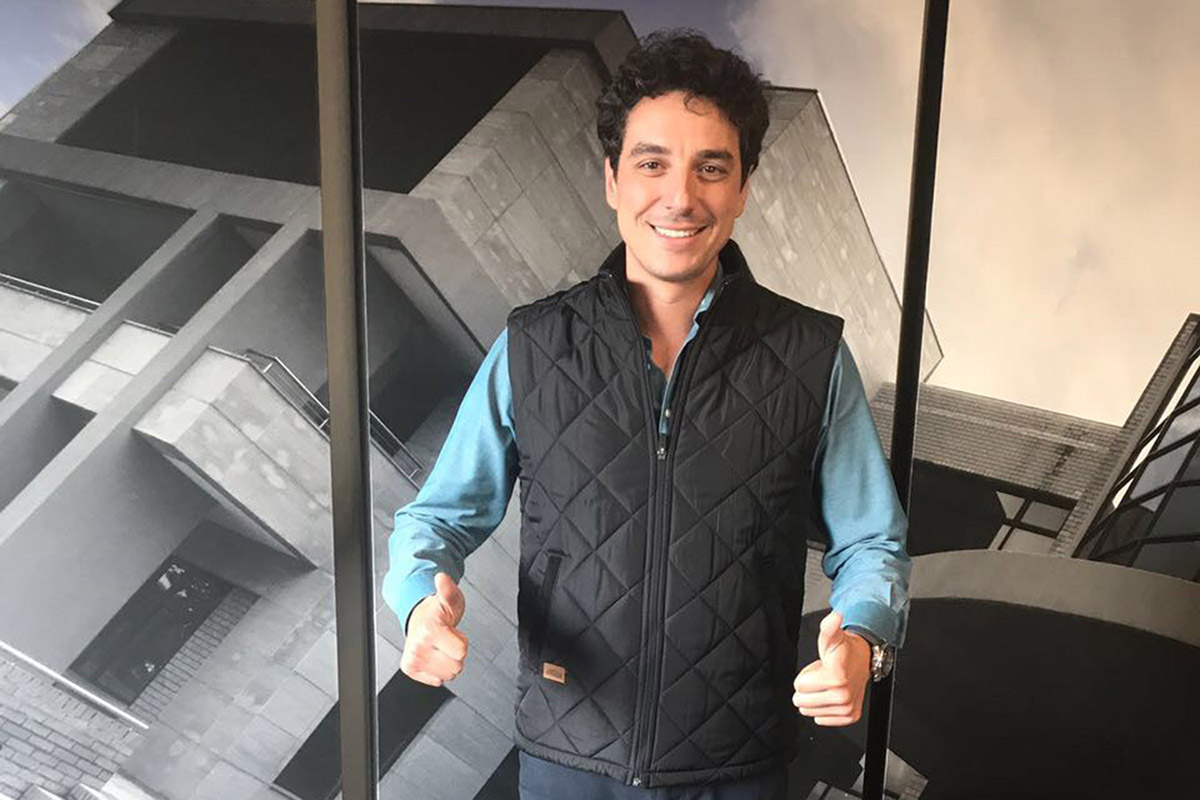
Atterbury Europe’s new asset manager is a true citizen of the world. Born and raised in the Romanian capital, Bucharest, as the only child of diplomat parents, Vlad Valcea was 15 when the family moved to Japan. After four years in Tokyo, young Vlad’s next destination was the US and New York, where he attended university. Before joining Atterbury, he had spent four years “on the road” between Romania, Ukraine and Moldova, as an asset manager covering Central Eastern Europe, travelling between malls in different cities across the same territory that he will now be covering in his new position.
“I believe it was an amazing coincidence that led me to Atterbury, and a perfectly timed matching,” says Vlad, who noticed the Atterbury Europe job posting a few days before it was due to expire in May this year. “The job title was exactly the same as what I was doing then, and so was the geographical area of coverage!” What he saw on the Atterbury Europe website about the deals in Serbia and Cyprus piqued his interest further, even though at that stage the Romanian acquisition wasn’t even public yet. “Even without that it seemed to me that this company had big future growth prospects in Central Eastern Europe, so when I heard about the the deal with Iulius Group in Romania, about a month later, I just thought to myself that this was a very fortunate coincidence…”
Vlad has not been to South Africa before, and his induction period in August included time spent in both the Pretoria head office and the Stellenbosch branch office. He’s not a complete stranger to the country though, as he heard stories from his father, now retired, who has visited a few times and rates it one of his all-time favourite destinations in the world. “I even knew that rugby is a second religion,” he confesses.
When asked about his hobbies, and a typical weekend, it turns out that Vlad and his fianceé, Natalia, are lovers of the great outdoors, who like to get out of the city to bike or hike or just visit the mountains or the seaside. Living in Bucharest, he explains they had easy access to all of the above, with the Black Sea a three-hour drive to the east, and the mountains two hours to the north. “In summer it gets really hot – up to 38 degrees Celsius, and heavy snowfall with temperatures as low as minus 20 degrees in winter.”
Responsible for asset management across the European portfolio, he’ll be based in Leiden, in the Netherlands with the rest of the Atterbury Europe team, starting on 1 September. Natalia will join him within a few months, and work will take him back to his home country and the region quite frequently between the assets in Serbia, Cyprus and Romania. “My first priority will be to visit all the projects in our European portfolio during September, so that I’ll have a full picture of the challenges ahead at the end of that tour,” he explains.
So what has it been like so far, working with the Saffers? Has he been treated to a braai? “No braai yet, but it’s coming soon! I was truly overwhelmed by the warm and smiley welcome that I received when I arrived at HQ in Pretoria,” Vlad enthused “I got the feeling of entering a great big family where everyone is looking after the other and genuinely feeling responsible about the outcome of their actions. So far, everything is ‘lekker’!”
As far as working for a “foreign” company in his home territory, Vlad is of the firm belief that Atterbury’s decision to set up an office in Europe was a good move. “There’s no better way to keep a finger on the pulse of the various opportunities that arise across the continent – and this way Atterbury can focus more effectively on managing its relationships with the local partners from different countries,” he says. “Just think – a flight from the Netherlands to Serbia (crossing over three, four other countries in between) takes the same amount of time as a flight from Johannesburg to Cape Town. Being there just makes sense.”
He does not believe that every foreign company that enters Europe will be at an advantage, but Vlad is convinced that Atterbury’s expertise, proven track record in an emerging market over more than two decades and the strong management culture will help it succeed. “Also, entering the region with a fresh eye and the belief in the potential growth of Eastern Europe’s developing economies puts Atterbury Europe at an advantage in seeing opportunities where others are being too conservative to act because of post-2008 amnesia,” he maintains.
Of course, a foreigh company faces very specific challenges, not least of which is to adapt to the particularities of each country. As Vlad points out, Europe might be the second smallest continent, but it has 43 countries compared to 54 in Africa, which is three times larger in size. “Europeans are very patriotic and very proud of their national cultural heritage, but they do consider themselves as part of the same greater continental family. Therefore navigating through these different cultures while being optimistic about the future of the European Union is something to always keep in the back of one’s mind,” he says. “However, I am not too concerned about this when it comes to Atterbury. From what I have experienced so far, my South African colleagues are very open and friendly while still remaining results-oriented. I believe these characteristics will help Atterbury adapt, integrate and ultimately succeed on the global playing field.”
Sharing his insights into the current state of the European retail and development landscape, Vlad explains that Central Eastern European countries are particularly strongly affected by the EU’s political environment and economic policies, but have nonetheless been posting very positive results on a multitude of macroeconomic indicators. “Disposable incomes have been increasing over the last three years, unemployment levels are low and back to pre-2008 levels, while financing costs are at their all-time historical lows. In such an environment retail has been doing extremely well, backed by consumer spending growing by double digits in the last few years,” he says. “In terms of development, I believe there is still room to grow in Eastern Europe, especially in the secondary cities where the modern retail space per inhabitant is still very low compared to Western Europe.”
Against this background, he’s looking forward to tackling projects as part of an innovative company and an enthusiastic young team, says Vlad. “I’ve only seen wonderful cohesion, superior motivation and an enthusiastic look to what the future holds. I can’t wait to get started.”