


Key Takeaways
- A developer’s track record is best judged by what happens after practical completion, not only by what was built
- Experience shows in master planning: infrastructure designed today for the requirements occupiers will have tomorrow
- Knowing when to phase, when to hold back and when the market is ready is a skill that only comes from delivering many projects
- Great precincts develop the ecosystem around the building, not just the building itself
Every developer will tell you they are experienced. For a corporate or investor weighing up who can reliably deliver a complex, large-scale project, the harder question is how to tell the difference. Years in business matter less than what those years produced, and whether the results are still working long after the ribbon was cut.
Atterbury has been developing, investing in and managing property for three decades, across mixed-use, commercial, retail and industrial sectors, from South Africa into the rest of Africa and Europe. You can explore Atterbury’s property development services for the full picture, but rather than list credentials, this article looks at three precincts and what each shows about how experience changes the decisions a developer makes.
By the end, you will know what to look for when assessing a developer’s track record, and why the answer is usually found in the precinct, not the brochure.
Master Planning for Tomorrow’s Requirements
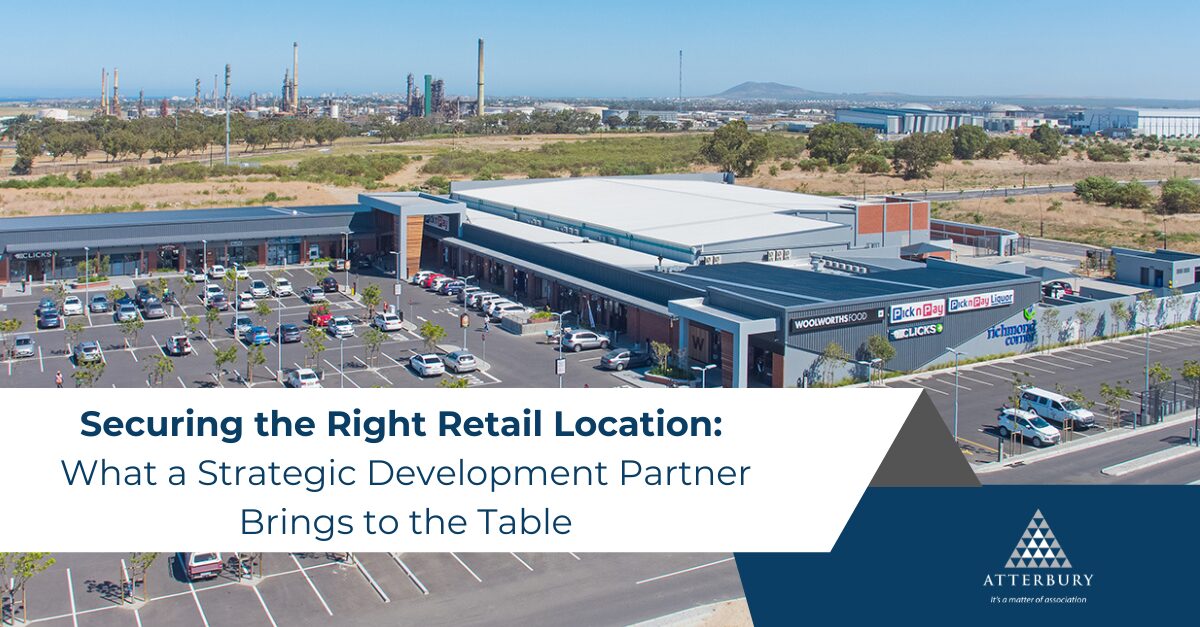
Richmond Park in Cape Town is a 300 000 m² mixed-use development on the N7, planned around occupiers who will keep growing. Road upgrades, fibre infrastructure and a dedicated power supply were considered as part of the master plan, not added when a tenant asked.
The result is visible in who has chosen it. Takealot, Solar MD, Rubicon and WeBuyCars have all established or expanded operations within the precinct. That is what experience means in practice: planning today’s infrastructure around tomorrow’s requirements, so a business can grow without having to move.
Knowing When to Phase and When to Wait
Castle Gate in Pretoria shows the evolution of a large mixed-use precinct rather than the delivery of a once-off building. The shopping centre opened in 2020. Offices and a gym followed in 2022, a further retail phase in 2024, and a residential component is now being developed alongside.
Each component arrived as the market and the surrounding area were ready for it. Experience teaches you when to phase, when to hold back and when the market is ready for the next piece. Those judgements rarely appear in a project description, but they are often the difference between a precinct that keeps gaining momentum and one that stalls.
Developing the Ecosystem, Not Just the Building
Atterbury did not approach Hazelwood as a collection of individual buildings. In the Old East Precinct, the focus progressively widened to development, tenant mix, roads, stormwater, parking, pedestrian movement, public space and day-to-day operations. Our own account of the precinct records more than R6.8 million spent on road and stormwater upgrades alone.
Village Walk, Bendehuis and Pantry are later layers of that thinking, each added once the foundations were in place. Experience teaches you to develop the ecosystem, not simply the building, because tenants and customers experience the whole environment, not a single address.
Recognition That Backs It Up
Track record is also reflected in how the industry sees a developer. Atterbury’s achievements include two SAPOA awards in 2026 for Bendehuis receiving the Best Commercial Development and the Overall Heritage award, a SAPOA mixed-use development award for Barlow Park in 2024, and recognition as the best Property Developer in the PMR.Africa awards for a 3rd consecutive year.
What to Look For in a Developer’s Track Record
When you assess a developer, look past completed buildings and ask three questions. Do occupiers stay and expand? Were infrastructure and phasing planned ahead of demand? Is the surrounding environment better for the development being there? The three precincts above are our answers to those questions, and our property development services apply the same thinking to every project, whether greenfield, adaptive reuse or a building conversion.
If you are assessing partners for a commercial, retail or industrial development, get in touch with our team and we will walk you through how this experience could apply to your project.