


Estimated reading time: 10 min
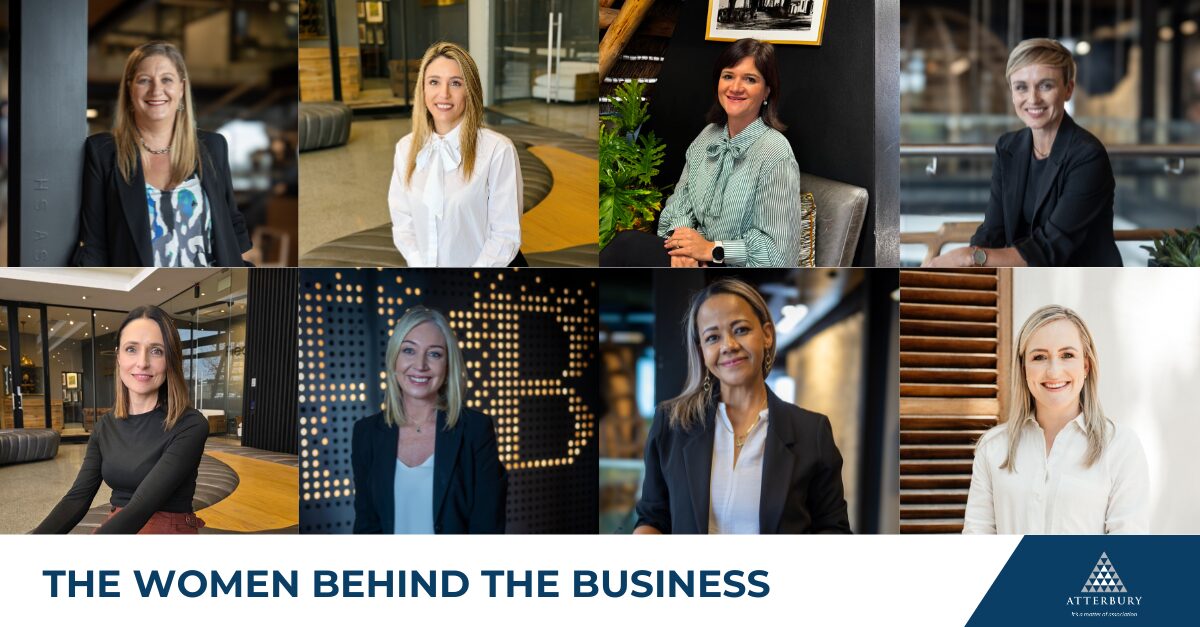
Commercial property is about far more than buildings. Behind every successful development is a team of specialists whose expertise shapes acquisitions, asset management, property management, legal strategy, marketing and people. This Women’s Month, Atterbury celebrates eight women whose work helps build lasting value across its commercial property portfolio.
What does it really take to build and sustain a property business?
When people think about property development, they naturally think about what they can see.
The skyline transformed by a new office building. A shopping centre opening its doors. A mixed-use precinct filled with people enjoying restaurants, cafés and public spaces. These are the milestones that become the public face of a development.
Yet every completed building tells only part of the story.
Long before a site is purchased, a lease is signed or construction begins, decisions are already shaping its future. Every opportunity must be identified, every agreement negotiated, every asset managed, every relationship nurtured and every challenge solved.
In many ways, property development is less about constructing buildings and more about bringing together the right people with the right expertise at exactly the right time.
It’s a business built on vision, trust, stewardship, collaboration and long-term thinking.
This Women’s Month, we look beyond the buildings through the voices of eight women whose work influences almost every part of Atterbury. Their responsibilities differ, but together they reveal what it really takes to build and sustain a property business.
Every business starts with opportunity
Every successful development begins with someone seeing potential where others may simply see an empty piece of land.
For Lucille, Executive Director and Head of Sales & Acquisitions, that’s exactly what makes her role so rewarding.
“For me, it’s the opportunity to imagine what a piece of land or a property could become,” she explains. “Every site or building has a story waiting to be written, and I enjoy looking beyond what’s there today to see its long-term potential.”
“The most rewarding opportunities are those that create value not only for Atterbury, but also for the communities and businesses that will benefit from them for years to come.”
When asked to describe the company’s approach to deal making in just three words, she doesn’t hesitate.
Relationships. Integrity. Long-term.
It is a simple answer, but it says a great deal about how Atterbury has built its reputation. Property is ultimately a people business, and every successful project begins with trust and a shared vision.
“Every project or deal has taught me something different,” she says. “What I find most rewarding is seeing a deal evolve from an idea into a thriving destination. Knowing that you played a part in creating places where people can work, shop, live or connect is incredibly fulfilling, especially when those assets continue to grow long after the deal has been concluded.”
“Every site has a story waiting to be written.”
Creating places people choose
If acquisitions mark the beginning of a property’s journey, asset management determines whether that investment continues creating value long after construction has been completed.
For Zandri, Asset Manager of the Castle Gate and Old East Precincts, success has little to do with bricks and mortar alone.
Instead, it’s about creating places that become part of people’s lives.
“I believe a precinct becomes truly successful when it evolves from a place people need to visit into a place they genuinely want to visit.”
That distinction, she explains, fundamentally changes the way people interact with a precinct.
“It is no longer purely transactional; it becomes experiential. People choose to spend their time there, meet friends, dine, work and return regularly.”
Those choices have a ripple effect throughout precincts.
Restaurants attract patrons. Patrons generate foot traffic. Foot traffic supports retailers and service businesses. Increased activity creates vibrancy, which attracts stronger tenants, further investment and stronger property values.
“To me, a successful precinct isn’t defined by the quality of its buildings alone. It’s defined by whether it creates an environment where people choose to spend their time. Once you achieve that, commercial success naturally follows.”
Managing mixed-use precincts, however, is far more complex than many people realise.
“Most people think it’s about buildings, leases and maintenance,” she says.
“It is largely about managing the interaction between people, businesses and competing interests.”
“A restaurant wants more outdoor seating. An office tenant wants quiet and convenient parking. Residents want security and a peaceful environment, while retailers need activity and foot traffic.”
“Success isn’t achieved by optimising individual properties. It comes from balancing the needs of the entire ecosystem.”
It’s also why Zandri believes the difference between a good property and a truly exceptional long-term asset lies in one word: relevance.
“Buildings age, market conditions change and tenant requirements evolve. The assets that continue to outperform are those that adapt while staying true to a clear long-term vision.”
“A successful precinct isn’t defined by its buildings. It’s defined by whether people choose to spend their time there.”
Relationships create long-term value
While Zandri focuses on creating exceptional precinct experiences, Nikki, Asset Manager of Atterbury’s Western Cape portfolio, approaches value from a portfolio perspective.
Ask her what creates long-term value in property and her answer isn’t financial.
It’s personal.
“I believe the key to creating long-term value in a property portfolio is relationships.”
She explains that Atterbury’s philosophy extends well beyond landlord and tenant.
“When you invest in meaningful relationships with tenants and suppliers, they become long-term partners. Valued tenants are more likely to renew their leases, and trusted suppliers continue to deliver quality service.”
“As our slogan says,” she smiles, “‘It’s a matter of association.'”
Managing a diverse portfolio means balancing people, properties and performance while adapting to new challenges and opportunities.
“What I enjoy most is that no two days are ever the same,” Nikki says. “Managing a portfolio requires balancing people, properties and performance, which constantly presents new challenges and opportunities. The variety keeps the role engaging and allows me to learn, adapt and grow continuously.”
“The asset that holds a special place in my heart is our retail asset in Pemba, Mozambique.”
“The property forces us to constantly think out of the box. Resilience and creativity aren’t optional; they’re survival skills! We love the challenge.”
“When you invest in meaningful relationships, tenants and suppliers become long-term partners.”
Bringing the bricks to life
By the time a development opens its doors, most people assume the hard work is over.
In reality, an entirely different chapter is only just beginning.
Buildings continue performing because they are carefully managed, maintained and adapted to meet the changing needs of tenants, visitors and communities.
For Isel, Managing Director of Management Services, that’s where her team’s work begins.
“We like to think that our property management teams bring the bricks to life.”
“People often only notice property management when something goes wrong,” she says. “But our team’s success is measured by the things that go right every day.”
Those “things” are far more extensive than many people imagine.
“Behind every thriving building are people coordinating tenant relationships, finances, maintenance, sustainability initiatives and long-term asset strategies. We don’t just manage properties, we create environments where businesses can succeed and communities can flourish.”
What keeps Isel motivated is surprisingly uncomplicated.
“When you are inspired, motivation follows naturally.”
“What keeps me energised is knowing that our work makes a tangible difference, helping tenants grow, supporting our clients’ investment objectives, and seeing our teams achieve more than they thought possible.”
“Don’t wait until you feel ready.”
“Some of the biggest opportunities in my career and my life, arrived before I felt fully prepared for them. I’ve learned that growth often starts on the other side of saying ‘yes’ and figuring it out along the way.”
“Confidence isn’t about having all the answers; it’s about bringing people together to find them.”
Or, as she puts it simply:
“Grow and take people with you.”
“We don’t just manage properties, we create environments where businesses can succeed and communities can flourish.”
Creating certainty behind every decision
While property management ensures developments continue performing long after completion, every project also relies on another discipline that rarely attracts attention but underpins almost every milestone.
Legal.
It’s a profession often associated with contracts, negotiations and risk.
For Natasha, Legal Manager, the reality is considerably more nuanced.
“One of the core functions of the legal profession is to manage and identify risk,” she explains.
“However, particularly within the property industry, it is equally important to understand the commercial reality of each transaction.”
That commercial understanding shapes legal drafting that is practical, protective and aligned with the realities of each transaction.
“It’s about appreciating the parties’ intentions, business objectives, timelines and relationships, and structuring legal drafting in a practical manner that reflects these factors while protecting everyone’s interests and mitigating risk.”
It’s a balancing act that requires far more than legal expertise.
It requires understanding people.
Understanding business.
Understanding property.
“Being part of the process and seeing the end result is incredibly rewarding.”
“After hours of negotiations and drafting, it’s fulfilling to see a signed agreement and, later, a completed project that reflects the original vision, knowing you played a role in bringing it to life.”
“I appreciate that property law often involves minimal or no conflict, which sets it apart from other legal fields, such as litigation.”
If there’s one misconception she’d like to change, it’s the idea that lawyers exist only to resolve disputes.
“Most people associate the legal profession with conflict, fighting battles and protecting interests.”
“However, it’s about far more than winning arguments.”
“It’s about creating certainty and structuring transactions in a way that limits risk while making them practical to implement.”
“We are problem-preventers, not just problem-solvers.”
Growing a business by growing its people
Every successful organisation has one thing in common.
Its people.
Buildings may define a skyline, but culture defines a company.
Few people understand that better than Ronel, Human Resources Manager, who has watched Atterbury evolve over many years.
When asked what makes the company’s culture unique, she doesn’t begin by talking about policies or organisational structures.
She talks about people.
“What makes Atterbury’s culture unique is its genuine focus on people, balanced with a strong entrepreneurial spirit.”
“People are encouraged to take ownership, contribute ideas, challenge thinking and get involved beyond their own roles, often collaborating with colleagues from different areas of the business.”
“People feel heard, valued and empowered to make a meaningful impact.”
“There is a real pride in the Atterbury brand, coupled with an appreciation that our success is built on our employees and the strong relationships we have cultivated over time.”
That sense of belonging, she says, is why so many people choose to build long-term careers at Atterbury.
“That sense of belonging is what makes Atterbury feel like more than just a workplace, and why so many people choose to build long-term careers here.”
“The most fulfilling part of my role is seeing people thrive.”
Her advice to anyone starting their career is thoughtful and refreshingly grounded.
“Stay curious, work hard and never stop learning.”
“Most importantly, be patient success is a journey, not a race.”
“Don’t focus only on the next promotion. Focus on building a reputation for reliability, integrity and excellence in everything you do.”
Giving the business a voice
For Kaylene, Group Marketing Manager, marketing is about giving meaning to the people, partnerships and purpose behind the buildings.
“To me, a brand is far more than a logo or a marketing campaign,” she explains. “It’s the identity, reputation and story that make a company unique. My role is to strengthen those stories in a way that’s authentic and true to Atterbury’s values.”
Since joining Atterbury, one project has stood out above all the others.
“It was the first development project I worked on after joining Atterbury, so I had the privilege of experiencing every milestone, from the earliest planning discussions to the opening and everything in between.”
“I wasn’t just documenting the journey; I had the opportunity to help shape the narrative of what Bendehuis has become. Even today, it’s a project that continues to evolve and create new stories.”
While marketing is often associated with creativity and social media, Kaylene believes that’s only a small part of the profession.
“Probably the biggest misconception is that marketing is just social media.”
“Social media is only one piece of a much bigger picture. Behind every campaign is strategy, research, planning, data, business objectives and a lot of collaboration.”
“Some of the most rewarding moments in my career have come from telling the stories of the people behind our developments.”
“It’s a special kind of privilege to be trusted with someone else’s story.”
Building more than developments
Throughout these conversations, one theme surfaced again and again.
It’s a philosophy perhaps best embodied by the work of the Atterbury Trust.
As Executive Head of the Atterbury Trust, Ananja sees what happens when a business measures success by more than financial performance.
“When I reflect on that number, I don’t see statistics.”
“I see 1,000 young people who were given an opportunity to rewrite their future. Many of them are the first in their families to attend university, and knowing that a single opportunity can change the trajectory of an entire family is incredibly humbling.”
“Those are the moments that remind me why we do what we do.”
Asked why it’s important for businesses to invest in communities as well as developments, her answer comes without hesitation.
“For me, this is what truly sets Atterbury apart.”
“We don’t only develop buildings, we invest in people.”
“Lasting success comes when businesses take responsibility for making a meaningful contribution to our country.”
“The Atterbury team has a remarkable ‘can-do’ attitude.”
“No challenge is ever too big, and there is a genuine willingness to step in, work together and find solutions that make a difference.”
“Everyone shares a heart for people, and that combination of excellence, humility and compassion is what inspires me every day.”
The business behind the buildings
Women’s Month often celebrates leadership.
Rightly so.
After spending time with these eight women, one thing became clear: leadership is defined by contribution.
Lucille reminded us that every great deal starts with someone seeing possibility before anyone else.
Zandri and Nikki showed that creating value doesn’t end when construction is complete, it grows through relationships, stewardship and a willingness to keep evolving.
Isel demonstrated that the best property management often goes unnoticed because success is measured by everything that quietly works.
Natasha highlighted that certainty, trust and sound judgement provide the foundation upon which every successful project is built.
Ronel reinforced that businesses don’t grow unless people do.
Kaylene reminded us that every development deserves a story worthy of the people behind it.
And Ananja brought the journey full circle by showing that the true measure of success isn’t only what we build, but who we uplift along the way.
It’s a reminder that behind every thriving development is an equally remarkable business.
And behind that business are people whose expertise, commitment and passion quietly keep the wheels turning every single day.
As Isel so perfectly puts it:
“Property is about buildings, but success is always about people.”


