

For Operations Directors and Facility Managers in logistics, manufacturing, or distribution, the search for new industrial space often ends in compromise. A warehouse might offer enough floor area but the wrong clear height for racking. A unit might sit on a good route but lack the yard circulation a fleet needs to turn and load efficiently. The right business, in the wrong facility, ends up spending years working around problems that should never have existed in the first place. We work with operations leaders who’d rather partner with our tailored industrial property development team from the outset, so the facility is built around the operation rather than the other way round.
Why Generic Industrial Stock Often Falls Short
Standard industrial units are built to suit a broad range of tenants, which means they rarely suit any one tenant precisely. Layout, load capacity, access, and location are the four factors that most often force a business into retrofitting space that was never designed for its specific workflow.
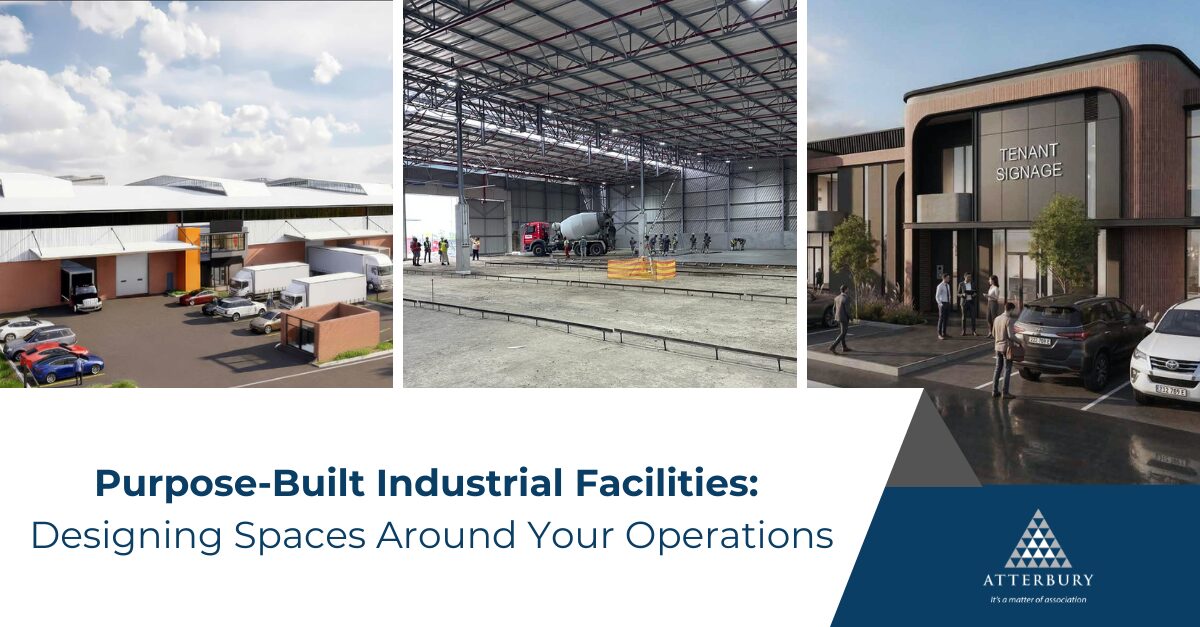
A logistics operation moving high volumes through a facility needs sufficient yard space for vehicles to manoeuvre, sectional doors positioned for efficient loading sequences, and floor surfaces rated for the equipment running across them daily. A manufacturer may need particular clear internal heights to accommodate machinery or racking systems, along with power capacity that standard speculative builds don’t always provide. When a facility doesn’t match these requirements from day one, the business absorbs the cost, either in lost efficiency or in the expense of adapting a building after the fact.
This is the gap that purpose-built development is designed to close. Rather than asking an operation to adjust to available stock, we start with the operational brief and design the facility to match it.
What Tailored Industrial Development Looks Like in Practice
Our recent work at Randport Business Park II in Germiston shows this principle in action. Positioned within the established Randport Industrial Park, the development comprises premium warehouse units incorporating modern office components, generous yard circulation, and dedicated parking. Each unit features eight metre clear internal warehouse heights, large sectional access doors, high-quality concrete flooring, and fibre-ready infrastructure, the kind of detail that only emerges when a facility is designed around how a logistics or light industrial operation actually runs day to day, rather than fitted out after the fact.
Richmond Park in Cape Town demonstrates the same thinking at a larger scale. As a mixed-use development integrating retail, light industrial, and office space on the N7 highway, the precinct was planned with road upgrades, fibre optic infrastructure, and dedicated power supply built in from the start, giving occupiers the operational backbone their businesses need without having to negotiate or install it themselves.
Within that same precinct, the Solar MD expansion illustrates what happens when a facility grows alongside the business inside it. Developed to support Solar MD’s rapid growth in battery energy storage solutions, the expansion increases production capacity while enhancing warehousing, testing, and logistics capabilities, all designed around the precision manufacturing and quality control processes the business depends on. It’s a clear example of the right business finding itself in the right facility, and growth following as a result.
Castle Gate Business Park, our limited release of premium units in one of Pretoria East’s established precincts, takes a similar approach for smaller-footprint operations. Units are designed for light manufacturing, warehousing, and showroom retail, with the built-in customer base of the surrounding mixed-use precinct adding a layer of commercial value that a standalone industrial unit could never offer on its own.
The Cost of Getting It Wrong, and the Value of Getting It Right
When operational requirements are treated as an afterthought, the costs tend to surface later and compound over time. Retrofitting a facility to accommodate equipment it wasn’t designed for, reworking yard layouts after operations are already underway, or discovering that power capacity falls short once machinery is installed are all expenses that a tailored development approach is built to avoid.
We take the opposite starting point. Before a single design decision is made, we work to understand the operational workflow the facility needs to support: how goods move through the site, what load capacities the floors and access points need to handle, and how the location itself supports the business’s distribution or production requirements. That data-driven approach, combined with thorough zoning analysis and site assessment, means the facility is shaped around the business case from day one rather than adjusted to fit it later.
Why Atterbury Is the Right Partner for Purpose-Built Industrial Development
Our development team manages the entire journey from land acquisition to occupation, which means the operational brief stays central to every decision along the way, not just the initial design phase. With decades of experience delivering industrial, logistics, and mixed-use developments across South Africa, we bring both the technical capability and the in-house asset management perspective needed to design facilities that perform for the long term, not just on opening day.
From the secure, connected logistics environment at Randport Business Park II, to the integrated infrastructure of Richmond Park, to growth-ready facilities like the Solar MD expansion, our portfolio reflects a consistent approach: understand the operation first, then build the space that lets it run at its best. For Operations Directors and Facility Managers who are tired of compromising on layout, access, or capacity, that approach is the difference between occupying a building and operating from a facility designed specifically for the work it needs to do.
Get in touch with our team to discuss your operational requirements and explore how a tailored industrial development could support your business’s next phase of growth.